
A preference case starts---and often ends---with an analysis of the most common defenses. These are the "subjective ordinary course of business" and the "new value" defenses. Antecedent is designed to help you understand how these defenses play out in a preference case, as these defenses are often the biggest (but certainly not the only) factors in what the settlement value of a preference case is.
The idea behind preferences is to make things fair for similarly situated creditors. Bankruptcy law disfavors a "race to the courthouse" where creditors try to take advantage of a debtor in distress and try to negotiate the best deal for themselves to get paid ahead of others. At the same time, it disfavors debtors who literally "prefer" certain creditors, paying them ahead of others. In other words, preference cases are about making sure that all creditors in the same boat are treated the same, even if that result may seem unfair to some individual creditors.
Preference cases are not about right or wrong. A creditor can have to pay a huge preference judgment even if they did nothing "wrong." It is not illegal to receive a preference, and the things that might lead to preference liability could be perfectly sound business strategies at any other time. It may seem very odd and downright hurtful to be sued for not doing anything wrong or even for taking actions reasonably necessary for a creditor's business. It is also tough for creditors who may have already lost money in a bankruptcy to have to pay back more.
That is ultimately why these defenses exist---to help ensure that creditors are not left in an unfair situation but to give them the opportunity to keep what they received by showing that would not be unfair to the bankruptcy as a whole. These defenses can be difficult to prove, however. That is where Antecedent comes in. Before talking about how Antecedent helps, we will start with a quick introduction to the two most common preference defenses:
New Value - You Get Some, You Give Some
New value (more accturately subsequent new value) is defined under Section 547(c(4)):
(c) The trustee may not avoid under this section a transfer—
...
(4) to or for the benefit of a creditor, to the extent that, after such transfer, such creditor gave new value to or for the benefit of the debtor—
(A) not secured by an otherwise unavoidable security interest; and
(B) on account of which new value the debtor did not make an otherwise unavoidable transfer to or for the benefit of such creditor;
What this means, in short, is that if a preference defendant receives a transfer of $500 from the debtor in the preference period, but then ships $250 in new goods on credit, the preference liability is reduced to $250. In other words, there is a "running total" of transfers and credits that decided the value of a preference. Each credit after a transfer can reduce the amount of the transfer.
One note: the Bankruptcy Code does not just create a ledger of transfers and credits and net them out. One of the reasons to use an app like Antecedent is to understand the timing of transfers and credits, as in life, for preference defenses timing is everything.
Subsection (A) means that the new value has to be unsecured---if the creditor takes security for the transfer it is not new value. Subsection (B) is important to understand. This section means that there is a crucial interplay between ordinary course and new value defenses. This can get confusing, and many bankruptcy practitioners get hung up on this. What this means is that the amount of new value can be reduced if there is ordinary course credit for a transaction. The idea is that a creditor cannot "double dip" by getting credit for providing new value, then getting paid on that new value, but being able to keep the payment because it was in the ordinary course.
Calculating this can be complicated and cumbersome. Antecedent's new value calculations takes this into account. Using Antecedent means that you get a correct calculation no matter how your other potential defenses play out.
The Ordinary Course of Business Defense - It's Not Unusual
The most complicated defense is often the "subjective" ordinary course of business defense. This defense creates more litigation than any other issue in preference cases, which is ultimately why Antecedent exists.
The ordinary course defense is defined by Section 547(c)(2):
(c) The trustee may not avoid under this section a transfer—
...
(2) to the extent that such transfer was in payment of a debt incurred by the debtor in the ordinary course of business or financial affairs of the debtor and the transferee, and such transfer was—
(A) made in the ordinary course of business or financial affairs of the debtor and the transferee; or
(B) made according to ordinary business terms;
First, there are two ordinary course defenses: one based on the ordinary course between the parties (the "subjective" defense) and whether the transfer was "objectively" within ordinary business terms. Antecedent is geared towards the former, but can help with the latter.
Second, under Section 547(g), it is the creditor that has to prove its defenses. While a plaintiff has to do its own due diligence into a case, ultimately it is the creditor that must prove its defenses in court.
The subjective test is the one that is often most important, and is the most complicated to figure out. Antecedent exists because correctly calculating this defense is difficult and requires a multi-step process.
Establishing the Baseline
Over time, cases have defined how the subjective ordinary course defense works. It starts with a "historical baseline of dealings." What the creditor must do is looks back to the past and establish how it dealt with the debtor. Often times, the key issue in a preference case is the timing between the day the creditor issues an invoice and the day the debtor pays it. While that is not the only potential issue in a case, it is often the most important.
To do this, the creditor needs a good amount of history to establish how the relationship between the creditor and the debtor functioned historically. Ideally this is a year or more of history. The creditor needs to show when it issues an invoice, what the terms were, and how long it took for the debtor to pay that invoice. Courts may reject ordinary course defenses if there is not enough history to provide an adequate baseline. Depending on what jurisdiction the bankruptcy case is in, there may also be a need to examine the debtor's financial state during that baseline. The short version is that the longer the history and the more invoice data it contains, the better it is.
Comparing the History and Preference Periods
The next step is to do the same for the preference period. If the debtor paid a creditors' invoice around 30 days from issuance, always paid by check, and did so consistently in both the historical period and the preference period, the changes of a viable preference claim are slim. However, if the debtor started paying more slowly or more quickly, there was a change in terms, or change in the method of payment, that may mean the payments were preferential and could be subject to clawback. The key to understanding a preference case is that comparison: how did the preference period match up to the practices established in the history? The answer to that question is often the key to whether a preference case is going to result in a large clawback or whether it may simply be dismissed.
There are many ways to make this comparison, most of which involve using statistics. The most common ways is to use "buckets" or "bins." In this method, all the invoices (both historical and in the preference period) are arranged in "bins" based on age (e.g. 0-5 days, 5-10 days, and so on). Then the number and total percentage of invoices put in each bin historically are compared to those in the preference period. How closely those "bins" match each other becomes a proxy for how ordinary the preference period was.
Based on the range of payment dates established in the history, a creditor can argue that invoices in the preference period that fall into that same range were ordinary and therefore not subject to a clawback. (Note that there may be issues like pressure from a creditor that may render otherwise "ordinary" payments subject to clawback.)
The "standard deviation" approach is another way of comparing the historical and preference period. However, this approach only works when the underling data is "normally distributed." Think of a classic bell-curve shape. It is very rare that companies pay invoices in a way to create a bell curve. More importantly, spreadsheets often do not check for the distribution of data, so they will create a "standard deviation" range, but one that does not account of the distribution of data.
Finally, there is the "total range" approach. This approach looks at the range of times between invoicing and payment in the historical period and says that any payments in the preference period that fall into the same range are normal. Courts have significantly narrowed this approach so that exceedingly long ranges do not qualify.
Note that in many cases first-time transactions may be protected. Even if a creditor starts doing business with a debtor in distress shortly before the debtor files that does not mean the creditor has received a preference. Generally if the creditor was paid within invoicing terms those transactions may be protected even without a historical baseline.
There are many nuances and other ways that clever bankruptcy attorneys can use to compare the historical and preference periods. Antecedent gives you the tools to see the data the same way that the other side of the case likely will.
Other Defenses
This is not an exclusive list of defenses. There are other defenses like "contemporaneous exchange for new value" or lien-related defenses as well. If those may be an issue, it is always a good idea to ensure a creditor has competent bankruptcy counsel to understand other potential defenses.
How Antecedent Helps
At its heart, Antecedent uses an open-source calculation system (the Preference Analysis Tool, or "PAT") to perform statistical comparisons between historical data and preference-period data. For example, Antecedent automatically completed a "binning" analysis and gives the user the opportunity to select a range, including some preset ranges. Antecedent also lets you know when a choice may not be advisable - for example selecting a total range wider than what is commonly accepted by courts will raise a flag. 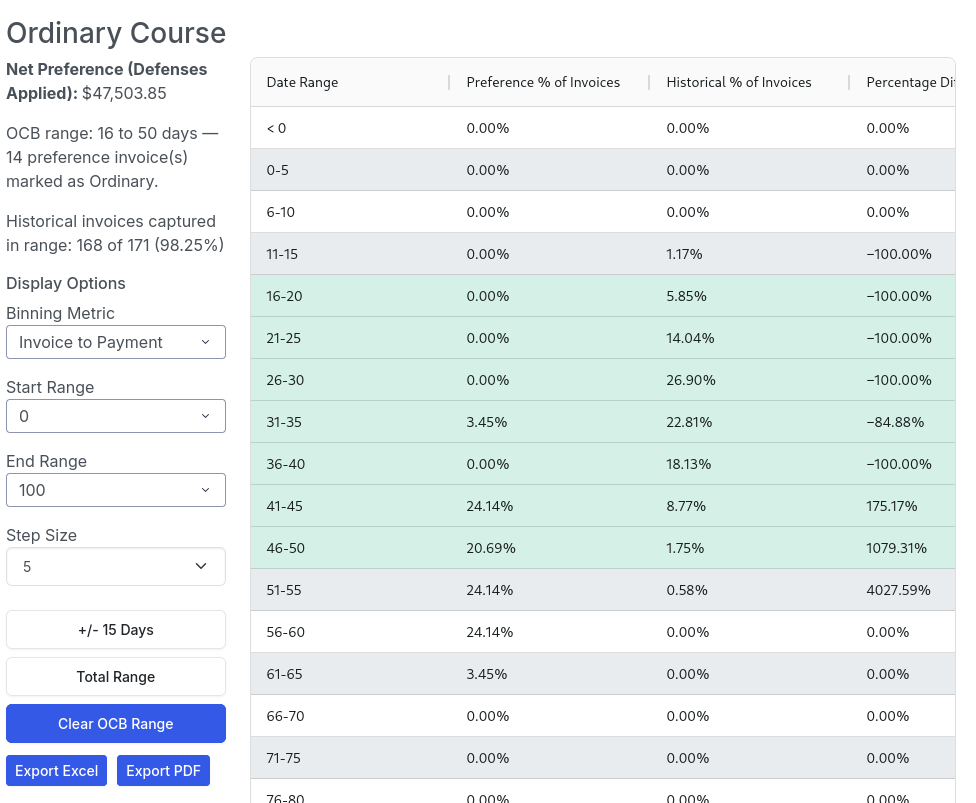 .
Antecedent also calculates the complicated interplay between defenses so that you do not have to. Antecedent then allows you to create charts, export data, and make the most of your arguments.
Antecedent is intended as a tool for attorneys, in-house counsel, and bankruptcy professionals. Antecedent is not a replacement for competent bankruptcy counsel. If you have been sued for a preference Antecedent can help you gather information is concert with in-house or external counsel. But Antecedent is not intended to provide legal advice---only a qualified attorney can help you navigate through a preference suit.